
 When it comes to the camping stove, there are lightweight backpacking models and large multi-burner models for car camping and base camp use. Camping stoves are further segmented by the kind of fuel that they burn. Some stoves burn liquid fuels like kerosene, alcohol, or a pressurized liquid like propane or a mixture of propane and butane. Solid fuel stoves burn wood, or a solid tablet like hexamine or trioxane.
All of the different types of fuels have their plusses and minuses. Propane is the most popular type of fuel, due to its ease-of-use and the readily available 1-pound canisters. Those canisters are heavy for backpacking, though, so manufacturers have introduced lower-pressure isobutane and isobutane / propane canisters that are much lighter, at about 5 ounces.
Canister Fuel Backpacking Stoves
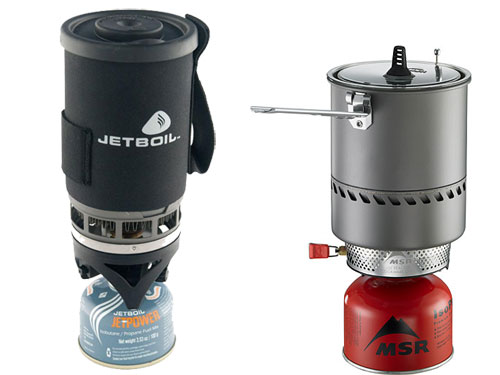
Backpacking stoves from Jetboil and MSR with integrated cooking systems
The latest trend in canister backpacking stoves is integrated cooking systems, like the Jetboil® Personal Cooking System and the MSR® Reactor® stoves. The major advantage of these systems is the integrated wind shielding around the burner. Even mild wind can have a huge impact on cooking time, because the breeze carries some of the heat from the burner away from the cooking pot.
Jetboil PCS
Cooking pot: 32 oz.
Dimensions: 4.1 in. diameter by 7.1 in. tall
Weight: 15 oz. without canister
Fuel: isobutane / propane canister
Canister Dimensions: 3.5 in. diameter by 2.8 in. tall
MSR Reactor
Cooking pot: 55 oz.
Dimensions: 6 in. diameter by 7.5 in. tall
Weight: 19 oz. without canister
Fuel: isobutane / propane canister
Canister Dimensions: 4.4 in. diameter by 3.5 in. tall
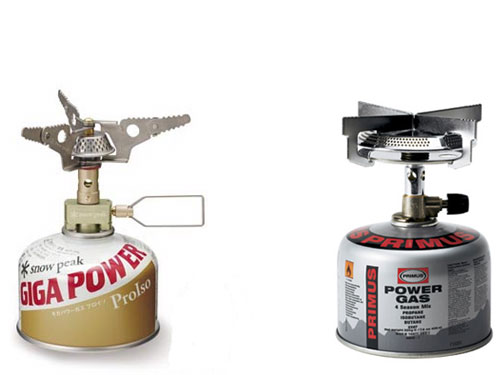
Lightweight backpacking stoves from Snow Peak and Primus
For the ultimate in lightweight cooking, traditional canister stoves mount a small burner and pot holder assembly on top of the fuel canister. The Snow Peak™ and Primus® fuel canisters are interchangeable.
Snow Peak New Lite Max
Dimensions: 3.88 in. diameter by 4.0 in. tall
Weight: 2 oz. without canister
Fuel: isobutane / propane canister
Canister Dimensions: 3.5 in. diameter by 2.6 in. tall
Primus ClassicTrailâ„¢ Stove
Dimensions: 4.9 in. diameter by 4.9 in.
Weight: 8 oz.
Fuel: isobutane / propane canister
Canister Dimensions: 3.5 in. diameter by 2.6 in. tall
Liquid Fuel Backpacking Stoves
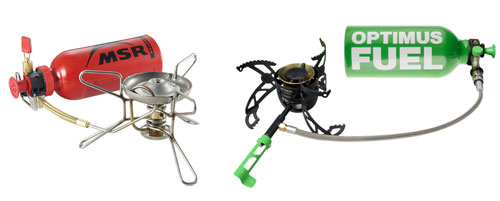
Liquid fuel backpacking stoves from MSR and Optimus
Liquid fuel backpacking stoves have a refillable fuel bottle that is connected to the burner assembly by a steal-braided hose. Being able to refill a fuel bottle, instead of replacing an empty fuel canister with a new, full one, can be an advantage on long trips. Particularly for air travelers, the refillable tanks are allowed (empty), while pressurized fuel canisters are not.
It’s also much easier to determine how much fuel is left in a bottle, since you can unscrew the cap and look inside. The only way to tell how much fuel is left in a pressurized canister is to judge it by weight, which not always an exact science. These stoves are generally more stable than their canister counterparts are, since the burner (and your pot) is not sitting on top of a fuel canister.
MSR Whisperliteâ„¢
Dimensions: 4Â in. by 4 in.
Weight: 12 oz.
Fuel: white gas, kerosene, jet fuel, unleaded gasoline
Optimus Nova
Dimensions: 5.5 in. by 3.5 in.
Weight: 15 oz.
Fuel: Optimus Arctic Fuel, white gas, kerosene, jet fuel, diesel
Propane Camping Stoves
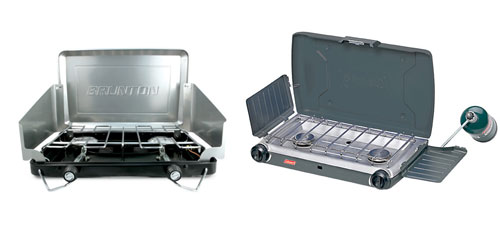
Propane camping stoves from Brunton and Coleman
There is no reason to restrict yourself to a single burner when you are car camping and that is what the popular two-burner propane stoves are really designed for. These stoves use the 1 lbs. disposable propane canisters, though they can also be outfitted with accessory hoses to fit larger, refillable propane tanks.
These stoves are available with and without piezo lighters, though they are simple to light with a match or a lighter. If there is one downside to these stoves and most propane-fueled stoves in general, it is very difficult to adjust the heat. They cook very fast, but don’t try to simmer anything.
Brunton® 2 Burner Stove
Burners: 12,000 BTU each
Dimensions: 18.5 in. by 11.5 in. and 3.25 in. high (closed)
Weight: 7.5 lbs.
Coleman® PerfectFlow™ 2-Burner
Burners: 11,000 BTU each
Dimensions: 21.25 in. by 13 in. and 4 in. high (closed)
Weight: 10 lbs
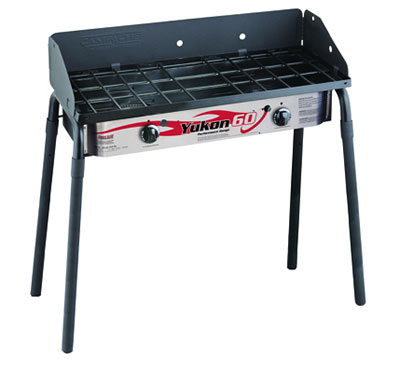
Camp Chef Yukon camping stove
Tabletop camping stoves are nice, but when you really want the ultimate camp kitchen Camp Chef® is the camping stove of choice. This 40-pound behemoth features a huge cooking surface that can handle the largest bean pots and griddles – at the same time.
Camp Chef Yukon 2-Burner Stove
Burners: 15,000 BTU each
Dimensions: 33 in. by 14 in. and 29.5 in. high
Weight: 41 lbs
Liquid Fuel Camping Stoves
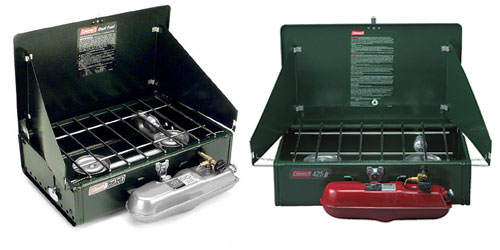
Liquid fuel camping stoves from Coleman
Many of us grew up with the Coleman® liquid fuel camping stove and you might be surprised to discover that they’re still available today. These camping stoves have a much more controllable heat range than their propane cousins and they can maintain their heat at high altitudes.
The downside to these stoves is that they take a bit more effort to operate than the propane stoves. You have to pressurize the fuel tank and preheat the burner, before cooking and there is a bit of an education process involved with getting it just right. See Coleman Liquid Fuel Camping Stoves for more in-depth information on these models.
Coleman Dual-Fuel 2 Burner Stove
Burners: 9,000 BTU (main), 8,000 (auxiliary)
Fuel: white gas, unleaded gasoline
Dimensions: 18 in. by 11.5 in. and 4.8 in. high (closed)
Weight: 9 lbs. 13 oz.
See also…
I have an Optimus multi-fuel stove and, until today, have only burned white gas in it. I work at the airport and have always wanted to try jet fuel (Jet-A) in it. I have always heard that Jet-A is very similar to kerosene but was warned that Jet-A is pretty stinky to work with. The prospect of a plentiful and inexpensive fuel supply, however, pushed me to try it out. I finally got some jet fuel in a bottle the other day and brought it home to try out. First off, it stinks! You do not want to even get a drop on you. You can’t get the smell off of you. I don’t care what kind of soap you use. Second…it doesn’t light with a match. I have know this as well, working in aviation. Jet fuel is very stable. The joke is that you put out your cigarette by throwing it in a bucket of jet fuel (I don’t advise you try it…but it’s probably true). Jet fuel, like diesel must be aerated in order to ignite. I had to pour a little bit of white gas on the stove in order to light it and “prime” it. Third…it smokes during the priming process. As the stove (and the jet fuel) heats up the jet fuel starts to burn and it smoked quite a bit – coating my entire stove in black soot. not a pleasant smell either. Once it was hot enough, and I opened the valve, it burned quite well (no smoke). The smell pretty much went away as well. I did have a bit of sputtering, but it may have been from insufficient pressure in my tank. I think you could avoid some of the smoke and the smell by priming with the paste or with some other fuel. My point from this little experiment is that jet fuel works in the stove, but I will only use it as a last resort.
The pictures on many of the camp stove you have included in your blog are awesome, i am happy to see those beautiful looking camp stoves with a flame burning on them..This is the reason that most of people should read this blog to gain knowledge about various types and designs of camp stones in the market
The pictures on many of the camp stove you have included in your blog are awesome, i am happy to see those beautiful looking camp stoves with a flame burning on them..
Enjoyed your review. Have used all backpacking stoves mentioned except jetboil. I am kind of a collector but haven’t gotten around to that one yet.
My favorite stove however is my almost 40 year old SVEA with the original Sigg Tourist cook kit. That thing is a workhorse and has been the most reliable piece of equipment I own.
Thanks for the article!!
Actually you can bypass pumping entirely on liquid fuel stoves I have some gadgets which replace the fill cap on the tank and you use a CO2 cartridge to pressurize the tank. A cartridge is supposed to last a full tank on either a stove or a lantern.
I have a two burner stove and have the attachment that pressurizes the fuel tank with a co2 cartridge and would like to see if these are still available anywhere?
Thanks
Moose
These devices are not advised and are no longer available thought the CO2 cartridges are. They have been known to bulge out lantern tanks especially if you use the ones designed for CO2 bb and pellet guns. If you really want to bypass the built in pump there are fuel caps available with a Schrader valve built in so you can use a Bicycle pump. These are sometimes available in stores that cater to the Amish….
i love my coleman stove its a coleman 425d my dad gave it to my uncle yrs ago and he gave it back to about 5 yrs ago ive used it a couple times a yr only thing i had to do was replace the generalter ill pass it down to my kids when i get with the right girl
The Coleman 425 stoves are definitely built to last, Jeremy – good luck with the whole girl-thing 🙂
I’ve used Coleman stoves since I was a kid. They are definitely dependable, and great stoves to cook on.
I have had and used the Optimus Svea stove for four years now and it hasn’t let me down yet! It is very light and a tough stove.
Hi there,
Where are you from? I see the LSP recommendation on places to camp with kids. I live five miles from the park and we frequent it.
Also, what do you consider essential winter gear? A buddy and I are planning a trip to Mt. Marcy out of Marcy Dam. Plan to go in February.
Thanks,
Rob
Hi Rob – I’m in northern California, but have friends from the Buffalo area. Essential winter gear is all about staying dry – so I like polypro base layers, which wick moisture away from the body and waterproof outer shells (jacket, gloves and pants or gaiters), when I’m in the snow. If you are going to be active (hiking, snowshoeing, etc.) then controlling body heat is the biggest challenge, because it’s easy to perspire faster than your clothing can handle it and you start to get wet – and as soon as you stop and cool down that moisture will freeze. This is why you hear so much about layering your clothes in cold weather – you can shed a layer to keep from sweating too much, then bundle back up once you slow down. It’s all about moisture, sweat from the inside, melting snow from the outside.
hiker – the goal was just to give an overview of the popular types of camping stoves on the market. I left out Nesbits and Sternos on the low end, and the big Camp Chefs on the high end.
Good basic run down of the different types of stoves. But is there a reason why an example of ultra light, home made stoves were left out?
For light weight hikers and campers that try to go as light as possible, the Whisperlight was the only example that might fit the bill. Canister stoves are ok. But when the canister is empty, you still have to carry it around.
Thank you for the article though.
I have a camp stove that runs on a can of Sterno (essentially an alcohol gel).
I pick up the Sterno at a catering supply store for cheap.
It helps when there is rain, and I can’t get a good fire going!
We almost always cook something for dinner on the campfire, whether its baked potatoes, corn, or just warming up tortillas. Something about a campfire makes everything taste better!
Good point, John – and I’d add that using crumpled-up newspaper to start the fire creates a lot of ash that ends up floating all over the place.
Another advantage of using a cookstove versus a fire: far less pollution and greenhouse gases in the atmosphere.
John Soares’s last blog post..Beautiful Photos of Yosemite Hike
I used to be against camp stoves. My thinking was camping means cooking on the fire. I used to cook everything on the fire; breakfast, lunch, and dinner… 2 summers ago I bought a cheap no name 2 burner stove from the big box store. I will never go back to camping without a stove. It’s nice to wake up and cook eggs and bacon with out fuss. I still like to cook dinner on the fire to “keep it real”. oh and that cheap no name stove is still going strong…
I wait until the local fire department has its’ annual hazardous materials program and they take them. I don’t know what they do with them but I’m sure it doesn’t end up in the local landfill. I’ve seen tanks, old stoves and just plain trash out in the wilds and it irks me to no ends to see that stuff.
I’ll bet the Trangia (http://en.wikipedia.org/wiki/Trangia) works good in the wind – that’s a weak spot with the current crop of backpacking stoves.
Jim – bugs the heck out of me that there is not a standard recycling program for those canisters. Some locations will only take them if you remove the valve, while others will take them as-is. I tried to go with a small 11-pound tank and a hose, but there is too much pressure-drop as the tank empties, and the stove doesn’t work as well.
Roy, I use that Coleman 2 burner propane all the time. It’s compact, easy to put in a rucksack and easy to clean up. And for the cost of the fuel, very economical. Just make sure you tote out what you tote in if the canister is empty. Keep America clean.
My wife and I (Hippy Chick) have used all types also, and have narrowed our stoves down to two. For “car camping” we use a small Coleman propane canister and screw on burner. For hiking/back country/kayaking we use a Trangia. The Trangia is similar to a cat stove but better built. Runs on just about any type of alcohol, but I use rubbing alcohol from the pharmacy and keep it in a mtn. dew bottle in the side pocket of my backpack.
Always wanted a whisperlight for the cool factor though. (I get small grins in the A.T. shelter when I get a through hiker with a whiperlight or thermojet looking at my Trangia) But hey, I’m old school that way. Just glad I have not had to whip out the Firestick.
Adam Shake’s last blog post..This Soldier Remembers a Fallen Comrade on Veterans Day-2008
I’ve been using a Coleman base camp stove like the first one pictured, except it has the side propane bottle like the second one pictured.
I recently went to a one-burner Coleman propane stove since my camping meals tend to be fairly simple.
John Soares’s last blog post..Tahoe National Forest Off-Highway Vehicle–OHV Plan