
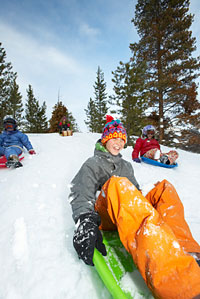
Proper layering techniques allow us to control our body temperature across various outdoor activities
The term “layering” gets bantered about with regularity when it comes to dressing for cold weather, but the mechanics of layering is often misunderstood and implemented improperly, resulting in frigid discomfort.
In order to understand how layering is supposed to work, you must first dispel with notion that clothes can make you warm. They can’t. The body actually generates the heat needed to keep itself warm, placing a particular emphasis on the heart and the brain. That is, if the heart or the brain starts cooling, the body will attempt to correct this by pulling heat away from the extremities. Our mothers knew exactly what they were doing, when they made us wear hats to go outside and play in cold weather!
Since the body generates the heat required to keep itself warm, dressing properly for cold weather is all about controlling this heat, so it either does not escape or, if the body is becoming too hot, that some of that heat will escape. Multiple layers of clothing are much more efficient than a single coat, because each layer creates an air pocket that stores some of the body’s heat. A single coat, no matter how big and heavy, only creates one air pocket.
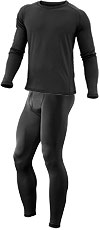
Marmot® uses a combination of Plartec and coconut shell husks in their baselayer garments
In addition to multiple air pockets to store the body’s heat and insulate the body from the cold, another important consideration is controlling perspiration. Normally, when the body gets too warm it creates perspiration on the surface of the skin that will evaporate, cooling the body. When we are wearing heavy clothes, however, this perspiration is trapped against the body, short circuiting the body’s cooling function and creating a vicious cycle as the body keeps trying to cool itself through more and more perspiration.
In cold weather, a build-up of perspiration on the body becomes dangerous when the excess moisture eventually defeats the ability of the clothes to provide insulation, and the perspiration freezes. This shocks the body, which up to this point had been trying to shed heat, and confuses the body’s internal thermostat.
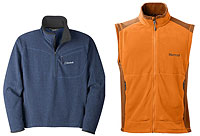
Fleece, like that used in the Cloudveil® pullover and the Marmot® vest, provides insulation while still allowing moisture to breathe
The process of layering, then, is to create multiple air pockets of insulation around the body, while allowing perspiration to be conducted away from the body. This was a tall task just a few years ago, but modern advances in synthetic fiber technology has made the principle effective and viable for all outdoor winter activities. The layering principle is comprised of the following three categories:
- A wicking layer that is both absorptive, pulling moisture away from the skin, and quick drying, passing the moisture on to the next layer. Look for polypropylene, Polartec® and polyester microfiber materials. The wicking concept also applies to the feet, where a thin polypropylene sock is used inside of a regular wool sock to keep the feet dryer and warmer.
- Insulation layer(s) need to trap the warm air created from body heat, but allow moisture from perspiration to keep moving. Vests are popular insulation layer, either standalone or in combination with another insulation layer. Look for Polartec, Windstopper and PowerStrech® materials.
-
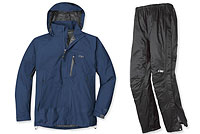
Gore-Tex®, like that used in shell products from Outdoor Research®, allows perspiration vapor to vent while blocking wind and rain
An outer shell layer needs to be able to block wind and rain but, like the other layers, also needs to be able to breathe. Popular materials are GORE-TEX®, Cloudburst®, Trinity®, and Precip®. Ventilation zippers are popular in shell jackets, to allow temperature control without removing layers.
It’s important to understand that the principle of layering is as much about temperature control as it is about the clothes. Well designed cold weather clothing is a tool that allows us to easily contain or ventilate heat, while all the time allowing moisture to escape. Throughout the day our clothing requires continuous tuning, depending on our level of activity, and an individual piece of clothing’s ability to facilitate this tuning is what separates the quality garments from the cheap stuff.
See also…
I’ve continued to look into this and there doesn’t seem to be an objective measure of the heat-trapping, insulating capability of different materials. You can find the weight per ounce, but not what that ounce will do. How does an ounce of fleece compare with an ounce of thinsulate. Is all fleece the same? Surely these are measurable factors.
Bill – I doubt that there is a standard measure of insulation that has been adopted by the industry (and the manufacturers certainly don’t publish it, if there is). One thing that Gore pointed out, with respect to layering, is that each layer is an inhibitor to breathing, because the vapor has to travel across the air-gap between the layers.
Roy,
It appears that any judgement about the insulating properties of various materials and the competing products made from them will be purely subjective. That leaves consumers with nothing but the marketer’s message.
Thank you for taking the time to respond.
You’ve done an good job of providing an overview of a layering system. My concern is with the insulation layer. I hunt waterfowl over water in sub zero wind chill conditions. I want maximum warmth with minimum bulk since I still need to mount a shotgun, no matter how cold it is. In the past I’ve used a couple (sometimes three) layers of wicking material such as under armour, polartec and a polypropolene type product and a single layer of fleece underneath my gortex shell. I’m wondering if the polypropolene adds significant insulation or just moisture control. Maybe I should be using a single layer of wicking material and multiple layers of insulation inspite of the greater bulk in the insulating material. I’m also wondering if any of this makes any sense. If so, I’d appreciate an opinion.
Interesting, Bill – I believe you are on the right track, looking at a single base layer. I’m actually at Gore today, so I’ll see what kind of ideas they have.
Thanks Greg, sometimes spellcheck is your friend and sometimes it’s the enemy 🙂
It’s “breathe” not “breath”
Yikes! I’d love to hear all the gory details sometime – I’ll send you an email.
Our camping trip was a disaster. The Kids loved it, I enjoyed it, but the wife hated it – So no more camping for us !!!!!!
Keep camping. Tell the wife to sit her ass at home and make you some dinner or clean or something. She shouldn’t tell you what to do, because she doesn’t like it.