
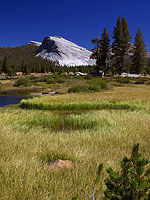
You don’t have to be an environmentalist or even that interested in green issues, to realize the importance of limiting your impact on the environment in the backcountry and preserving what we have left, for future generations to enjoy.
Limiting your impact on the environment is just a smart way to camp and it doesn’t matter if you are camping in a tent or a million dollar RV. In addition to the seven standard Leave No Trace principles, here are some steps you can take to lower your impact on the environment:
Camp in campgrounds. Dispersed camping, or camping outside of designated campsites, is a great way to go camping, but there is no way to match a designated campground for low-impact camping. For instance, designated campgrounds have toilets, gray water traps, garbage cans and fire rings.
Prepare meals at home. One of the easiest ways to practice low-impact camping is to reduce the amount of pre-packaged food waste that we take with us into the backcountry. One of the worst culprits that we discovered was our kid’s juice boxes. The cellophane straw wrappers become detached from the boxes and end up all over the place and the inside of the box is coated with some kind of foil or plastic liner. Whatever it is, I’m sure it has no business in a campfire.
Don’t burn trash in the campfire. We used to burn everything that was paper or cardboard, which is how we discovered what was inside a juice box, but we now try to limit what we put into our campfire to just wood. Ash from paper and cardboard tends to be carried aloft by the campfire and spread over a fairly wide area.
Use as much garage sale gear as you can. Outdoor manufacturers like Patagonia, Nau, and Big Agnes are making greener products all the time, but it’s hard to get lower-impact than reusing old gear.
Limit your use of water for cleaning and washing. Drinking water is valuable in the backcountry, so preserving as much of it as you can for drinking just makes good sense. There are a number of waterless soaps and shampoos on the market that work great and don’t generate dirty, soapy water (gray water) that must be disposed of.
Make your own snacks. What doesn’t burn or decompose in landfills? Well, lots of things of course, but energy and breakfast bar wrappers are what I was getting at. Most of them are junk anyway, so do yourself two favors and make your own trail mix or gorp at home.
Simple Trail Mix
1 can (11.5oz) of mixed nuts
1 cup of peanut M&Ms
1 cup of raisins
Stop using disposable propane tanks. This won’t be popular with the manufacturers, who are increasingly churning out products that use the 1lb. disposable propane tanks. Adapter hoses are available that let you use refillable propane tanks instead of the disposables, though.
See also…
”Make your own snacks. What doesn’t burn or decompose in landfills? Well, lots of things of course, but energy and breakfast bar wrappers are what I was getting at. Most of them are junk anyway, so do yourself two favors and make your own trail mix or gorp at home.
Simple Trail Mix
1 can (11.5oz) of mixed nuts
1 cup of peanut M&Ms
1 cup of raisins”
How does this help reduce your environmental impact compared with buying a trail mix/ energy bar from a store? You have now bought three tins instead of ONE bag/wrapper. When you make your own ‘trail mix’ it is likely you have to dispose of the original containers thus damaging the environment and when you carry the new mix on the mountain surely your new container will need disposing?
I don’t like this.
Pingback: Garage Sale Gear: Dana Design Direct Backpack | eluctor.com
Dan – that’s right, there are several gear makers starting to use shredded plastic (I forget the exact name – but it’s recycled plastic bottles) for insulation.
VE – My travel channel is http://www.vehow.blogspot.com 🙂
Jean – I was skeptical of the shampoo.
Pingback: Reduce your Camping Impact on the Environment | Camping Tip
We don’t use propane at all, and we do usually stay in campgrounds. Personally, I have never found a waterless shampoo that works.
You forgot: Stay home, watch the travel channel…that should clear up the woods from tourists…
VE’s last blog post..The Wind Blows…
Mountainsmith has some gear in their line made from recycled materials. I can’t think of who else I’ve seen who does, but it’s another bag/pack maker.
Where can one find the adapter you’re talking about?
Dan’s last blog post..How To: Make Your Own Tinder
very good article, but i think this won’t change something…
John – don’t feel bad, I’ve still got two of the bottles. I’ve got a picture of my new setup (a small 11lb. bottle with an adapter hose) at home, but I’m in L.A. on business this week so I wasn’t able to post it with the article.
Joshua – you’re right about the waterless stuff, it’s not the same as a shower! We’re pretty happy with the hand sanitizer, but we haven’t ever tried the shampoo.
I love the point about old gear being more environmentally conscious than new green gear. Great! I’m not on board with the waterless washing because I haven’t seen one that makes me feel like it works well, but maybe I just haven’t found one. The propane tank thing is something we’ve done in our Scout troop (hose system to hook up multiple items to a big propane tank), but I don’t know how to do that personally when hiking. I don’t use propane for that, though, as I use an alcohol backpacking stove.
Roy, very good and very timely post.
I’m guilty of using the disposable propane bottles. I’ll look at your solution once I get through the full ones I still have.
I also primarily do dispersed camping — camping outside of campgrounds. I do everything I can to minimize the impact, but you correctly point out that being in a campground is overall better for the environment.
John Soares’s last blog post..How Writing College Textbook Supplements Helps Your Writing Career – and Could Get You a Job with a Textbook Publisher